Maurice Sendak's Macbeth
Up for auction at Sotheby's now, the high school assignment that paved the way for Where the Wild Things Are

Have you seen High Wire: Calder’s Circus at 100 at the Whitney? If so, you’ll know how hard it is to tear yourself away. Surprise! I was running late when I raced out the revolving door two weeks ago to catch the matinee of Arabella at the Met. Meant to dash to the subway, but instead hopped a waiting cab with its nose pointed straight to the West Side Highway, and named my destination. “Lincoln Center!,” the cabbie exclaimed. “My grandmother use to take me to the opera and the ballet there all the time!”
Decades ago, she taught high school in Brooklyn. One day ca. 1943, she assigned her class a paper on Macbeth. But she’d noticed that one of the students who was floundering was also sketching all the time.. So, she asked him to give her drawings instead. His eight illustrations remained with her the rest of her life. In a hand-written letter Maurice Sendak sent her years later, he acknowledged how crucial her encouragement had been for his future career.
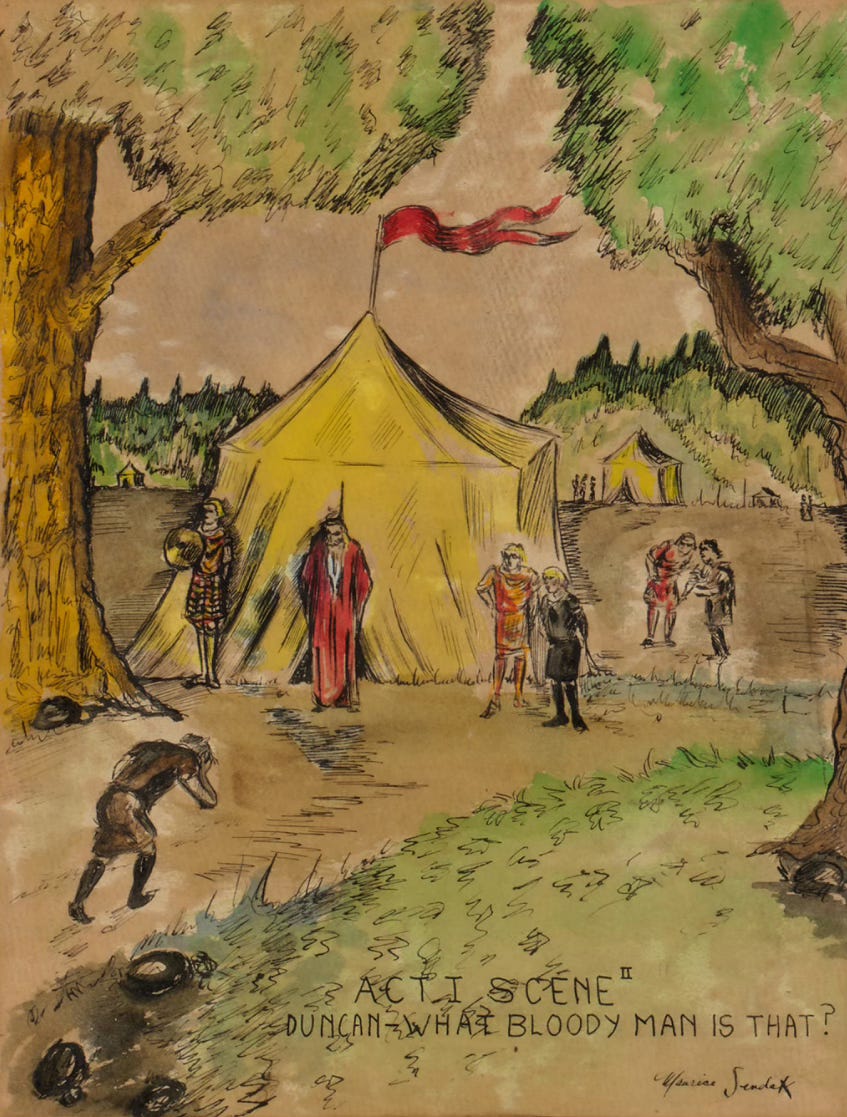
“And right now, the drawings and the letters are up for auction at Sotheby’s,” my driver told me. At a red light, he brought up the images on his phone and let me forward them to mine—proof of what must sound like a tall tale. For higher-res shots, a fuller account of the story, and quotes from Sendak’s letters, check out the lot listing in Sotheby’s online catalogue.
Here’s extra info straight from the horse’s mouth. According to my driver, Sendak reached out after his grandmother died, hoping to retrieve the Macbeth portfolio. My driver proposed a swap: Macbeth in exchange for new art to go on the labels of a line of healthy fruit drinks for kids. Sendak seems to have loved the idea. But under a recent exclusivity contract with a media giant, his hands were tied. And here we are.
From what he told me, my driver isn’t all that keen to sell. So, he set what he said was a high reserve. To my way of thinking, the time has come for the images along with the letters that tell the story to move to an appropriate research collection. The Maurice Sendak Foundation seems the most fitting, but other repositories have significant Sendakiana as well, among them the University of Connecticut, in Storrs; The Rosenbach Museum and Library, in Philadelphia; and the Morgan Library & Museum, in New York. Here’s hoping the lot now at Sotheby’s is on their radar.
On an art-historical note (ahem!), I’ll suggest that Sendak’s Macbeth series suggests the influence of Classic Comics (later Classics Illustrated). The series—text-heavy, as Sendak is not—launched in 1941 with The Three Musketeers, in time for young Maurice to have assimilated the first eight titles by the end of 1942. For the record, the final Classics Illustrated—the double issue Negro Americans: The Early Years, No. 169, featuring backgrounders and capsule biographies of figures like Harriet Tubman, Fredrick Douglass, and Booker T. Washington—appeared in 1969.1 Of course, the editors eventually got around to a Macbeth of their own; it’s No. 128, published in September 1955 at 15 ¢.
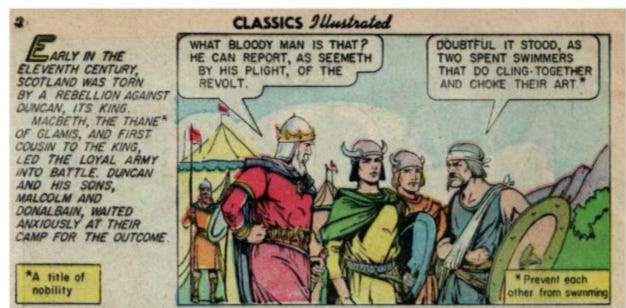
Yes, the digits look suspiciously alike, but they’ve been double-checked.